
Our Story: A Legacy of Faith, Unity, and Service
Welcome to Masjid Al-Islam of Slidell. We are a vibrant, multi-ethnic spiritual home locally run and operated by the brothers and sisters of Slidell. Our doors, our hearts, and our facilities are permanently open to our local neighbors, traveling believers, and visitors of all faith backgrounds who wish to learn, find peace, or seek support.
Built on the land of the indigenous people of the Chahta tribe, Slidell Masjid of Al-Islam is one of the oldest masajid in the state of Louisiana. Under the guidance of our leadership, we strive to build a community where true faith is expressed through tangible service to humanity, deep spiritual education, and warm hospitality.
A Singular Piece of Louisiana History
While our community looks forward to the future, we stand firmly on the shoulders of giants. Established in 1970, Masjid Al-Islam holds a unique, historic distinction: It was the first structure designed and physically constructed from the ground up to function explicitly as a mosque in the entire state of Louisiana.
While other early Muslim communities across the state began by renting storefronts, converting residential houses, or gathering in temporary university campus halls, the founders of the Slidell Masjid laid a foundation with a definitive, permanent architectural intent. They built a dedicated house of worship designed precisely for Islamic congregational life, featuring a proper architectural layout aligned toward Mecca (qibla), a peaceful main prayer hall, and dedicated spaces for communal gathering.
The Convergence of Three Communities
The physical walls of our masjid tell a story of cross-cultural unity that is rare in American religious history. The founding of Masjid Al-Islam represents a beautiful, deliberate alliance between three distinct cultural groups on the Northshore who chose brotherhood over division:
- Indigenous African American Muslims: Planting the original seeds of the community in 1970 as a local hub of spiritual autonomy and self-determination during the Civil Rights era.
- South Asian Immigrant Families: Pioneering Muslim professionals, doctors, and engineers who began settling in St. Tammany Parish in the late 20th century and sought a permanent spiritual sanctuary for their children.
- The Native Choctaw (Chahta) Tribe: Local families carrying deep ancestral roots in the land who found a spiritual home and common bond within the message of Islam.
Rather than fragmenting into separate ethnic spaces, these three groups pooled their resources, their labor, and their prayers to erect a single, unified house of worship. This profound legacy of cross-cultural collaboration was officially recognized by the Louisiana Endowment for the Humanities (LEH), which awarded a historic preservation grant to help archive, document, and digitize the oral histories and early records of our pioneers.
Leadership Rooted in Justice: Imam Haqq & Sister Theonette
It is only appropriate for this historic mosque to be led by Imam Haqq, who identifies as an indigenous Muslim, and whose commitment to truth and justice are qualities with which he continues to lead and inspire his community.
As an elder of both the Muslim community and the Chahta community, Imam Haqq has witnessed some of the most painful, as well as most transformative, times in United States history. Formerly a member of the Nation of Islam, he transitioned his family and the mosque to traditional Islam in the 1970s under the global Sunni tradition.
Imam Haqq and his beloved wife, Sister Theonette, were fiercely active in the fight for civil rights and continue to push for equity and integration in the Slidell community. Their unwavering commitment to caring for and supporting people within the community—whether they are Muslim or not—continues to remain strong.
Known for his open-door policy, Imam Haqq works tirelessly to bridge generational gaps, foster interfaith dialogue, and ensure that the masjid remains a safe, welcoming haven for anyone seeking spiritual counsel or practical help.
Our Programs and Community Outreach
Faith at Masjid Al-Islam is an active, everyday pursuit. We host robust, ongoing programs designed to nourish the soul, educate the mind, and feed the hungry:
- Daily Congregational Prayers & Jummah: We host the five daily prayers in congregation, as well as the weekly Friday Jummah service, providing a powerful spiritual anchor in the middle of a busy week.
- Weekly Sunday School: Our dedicated youth programs focus on nurturing the next generation, teaching foundational Quranic studies, Islamic character (achlaq), and community values in a supportive environment.
- The Community Food Pantry: The living testament to Imam Haqq and Sister Theonette’s legacy is their dedication to open the masjid’s doors twice monthly to nearly 200 families within the community who are in need of food assistance during these difficult times. We distribute food and essential goods to anyone experiencing food insecurity—completely free of charge, with absolute dignity, and with no religious restrictions. If you are in need, our doors are open.
Facility Accommodations for Members and Travelers
We take great pride in maintaining a clean, comfortable, and accommodating environment for our local congregation and travelers passing through the Interstate 10/12 corridor:
- Welcoming Main Prayer Hall: A spacious, beautifully lit, carpeted space designed for deep prayer, reflection, and community lectures.
- Dedicated Women’s Section: A private, comfortable, and fully integrated prayer and meeting area for the sisters of our community.
- Clean Wudu & Restroom Facilities: Well-maintained, specialized facilities for ritual ablution (wudu) and restrooms to ensure absolute comfort and cleanliness before prayer.
Join Us
Whether you are moving to the Northshore, traveling through south Louisiana, looking for a place to volunteer, or simply curious about Islam, we invite you to experience the historic warmth of Masjid Al-Islam.
“My hatred for injustice and racism is what led me to Islam” – Imam Haqq
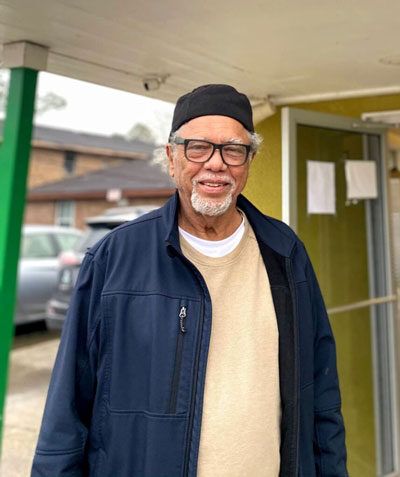
Imam Haqq grew up in the South during segregation. His experiences ignited within him a passion for justice and equality- which he believes is what led him to Islam.
Islam at its core combats and eradicates racism and injustice, and this is too what Imam Haqq strives for as the leader of the Slidell Masjid of Al-Islam.
Imam Haqq and Sister Theonette’s generosity and warmth are best reflected in the atmosphere they’ve created at the masjid; anyone who walks through the doors feels welcome and valued.